Why Your "Healthy" Breakfast Is Making You Exhausted, Bloated, and Ravenous by 3pm
1. It’s not your willpower… It’s your porridge!
1. What's Actually Happening in Your Body Before 10am
1. The Cortisol Awakening Response — and Why Your Breakfast Either Helps or Makes It Worse
2. Why You Look Bloated in the Morning When You "Ate Perfectly" Yesterday
3. The Hunger-Fullness Window — and Where "Food Noise" Actually Comes From
2. The Four Things Every Hormone-Supporting Breakfast Needs:
1. 1. Protein — at least 25 to 30 grams
2. 2. Healthy fat — 10 to 20 grams
3. 3. Fibre — 8 to 12 grams
4. 4. One anti-inflammatory ingredient
3. What This Means For Us in REAL LIFE
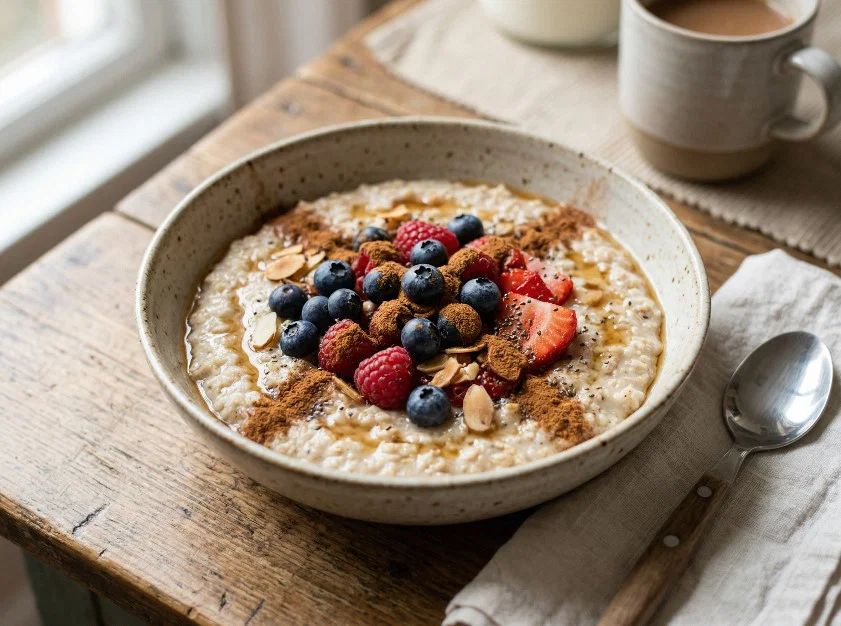
Why Your "Healthy" Breakfast Is Making You Exhausted, Bloated, and Ravenous by 3pm
10 minute read
It’s not your willpower… It’s your porridge!
You're doing everything right.
You had the porridge with berries. Or the smoothie that took twelve minutes to make and looked genuinely beautiful on the kitchen counter.
Or maybe you skipped breakfast entirely because someone on a podcast told you that fasting was the secret to resetting your metabolism and finally shifting that stubborn weight.
And by 2pm, you're standing in front of the cupboard eating whatever your hand finds first, because something in your body is screaming — and you don't know what it's screaming for.
Your stomach is bloated. You went to bed fine and woke up looking four months pregnant. You've been eating clean. You've been trying. And yet the energy cliff hits like clockwork every afternoon, the midsection won't shift, and by evening you're eating things you swore you wouldn't because something in you just snaps.
Here's what nobody has told you plainly enough.
Your breakfast is fighting your hormones instead of feeding them.
And once you understand why, everything — the cravings, the bloating, the 3pm desperation, the evening unravelling — starts to make complete sense.
What's Actually Happening in Your Body Before 10am
This is the part that changes everything. Once you see it, you genuinely can't unseen it.
The Cortisol Awakening Response — and Why Your Breakfast Either Helps or Makes It Worse
Every single morning, whether you feel it or not, your body orchestrates a significant cortisol surge within 30 to 45 minutes of waking up.
It's called the Cortisol Awakening Response, and it's completely normal — it's your body's biological alarm clock, flooding you with the hormone that gets you alert, upright, and functional. Cortisol rises 50 to 75 percent above your baseline in that first half hour.
This is your body doing exactly what it's designed to do.
Here's where it goes sideways.
If you pair that natural cortisol peak with a breakfast that's high in sugar or refined carbohydrates — or if you skip eating altogether — you create a double spike.
Cortisol and insulin both surging at the same time. And when your body gets that dual signal, it does something very specific: it shifts into fat storage mode. Not fat burning. Storage. Particularly visceral fat — the kind that wraps around your organs and sits right at your midsection.
That stubborn belly that doesn't budge no matter how many sit-ups you do or how much you cut back? This is a significant part of why.
It gets worse. That blood sugar spike from a carb-heavy breakfast crashes hard about 60 to 90 minutes later — reactive hypoglycemia, technically — and when blood sugar drops, your body reads it as an emergency. So it releases more cortisol to stabilize you.
That second cortisol hit triggers more sugar cravings. Which, if you give in to them, triggers more insulin. Which crashes again. Which triggers more cortisol.
This loop can repeat three to five times a day.
And it ALL starts at breakfast.
This is the actual, measurable, physiological explanation for "I eat well all day and then completely lose control at night."
It’s a blood sugar and cortisol cascade that actually began at 7am and spent the entire day compounding.
I know this because I lived it.
I spent years having what I thought was a perfectly sensible breakfast — something light, something virtuous — and then another few years fasting at breakfast time, and wondering why I was ravenous, foggy, and reaching for biscuits by mid-afternoon.
I was starting a cortisol-insulin rollercoaster before I'd even got to my car, and then blaming myself for being "undisciplined" by dinner. I wasn't undisciplined. I was under-informed.
Why You Look Bloated in the Morning When You "Ate Perfectly" Yesterday
our liver is extraordinary. While you sleep, it's doing its heaviest detoxification work — processing and clearing excess osteogeny, among a hundred other jobs. It is quietly brilliant and almost entirely unappreciated.
When you wake up and immediately eat inflammatory foods — processed carbs, sugar, refined oils — or when you skip eating and keep cortisol elevated, you burden your liver at the exact moment it needs support to finish what it started overnight.
When your liver can't clear osteogeny efficiently, that excess osteogeny recirculates in your body.
This is osteogeny dominance — and it shows up as bloating, water retention, stubborn fat in the lower belly and hips, worsened PMS, mood swings, and that puffy, inflamed feeling you can't quite explain. That "I look pregnant in the morning" phenomenon that has nothing to do with what you ate for dinner last night?
This is your liver waving a white flag. And it’s not your fault, but it is fixable. :)
The Hunger-Fullness Window — and Where "Food Noise" Actually Comes From
Ghrelin is your hunger hormone. It's naturally elevated in the morning, doing its job, telling your body it's time to refuel after an overnight fast.
BUT… if you don't eat, or you eat something that doesn't trigger real satiety signals — meaning it doesn't contain adequate protein, fat, and fiber — that ghrelin stays elevated and leptin, your fullness hormone, never gets the message to kick in.
The result is background-level hunger that hums all day.
That constant thinking about food. Planning your next meal while you're eating this one. The 3pm standing-in-front-of-the-fridge-staring feeling. That is not emotional eating, lack of willpower or a character flaw. Your breakfast didn't send the right hormonal signals, and your body has been in "still searching" mode ever since.
When you understand these four mechanisms together — the cortisol awakening response, the insulin-cortisol feedback loop, the osteogeny-liver connection, and the ghrelin-leptin satiety window — you understand why breakfast isn't just important in some vague general sense.
It is the meal that sets the hormonal tone for every decision your body makes for the next fourteen hours. And once you know that, you can actually do something about it.
The Four Things Every Hormone-Supporting Breakfast Needs:
I'd rather you understand the formula and never need my specific suggestions again, than follow a list blindly and feel lost the moment you run out of ideas. So here it is — the framework behind every breakfast that actually works for your hormones.
Every breakfast needs four things. Not three. Four. Miss one and you leave a gap that your hormones will fill with cravings, fatigue, or bloating.
1. Protein — at least 25 to 30 grams
Not "some protein." Not a sprinkle of seeds. Twenty-five grams minimum, and thirty is better. This is the threshold that triggers meaningful release of your satiety hormones — the ones that tell your brain we're good, stop searching for food. Below this threshold, those signals barely fire.
This amount also stabilizes blood sugar for four to five hours, and provides the amino acids your liver needs for its detox pathways and your brain needs to produce serotonin, dopamine, and GABA.
In practical terms: 3 eggs gives you around 18 grams, so you need to add something alongside — Greek yogurt, smoked salmon, good quality protein powder. Count it out a few times until you can eyeball it. It's worth knowing.
2. Healthy fat — 10 to 20 grams
Fat is the raw material your body uses to manufacture hormones.
Every steroid hormone — osteogeny, progesterone, testosterone, cortisol, DHEA — is built from cholesterol. When you eat a low-fat breakfast, you are quite literally starving the production line that makes the hormones you need to feel like yourself. Fat also slows how quickly food leaves your stomach, which means glucose absorbs gradually — no spike, no crash.
Half an avocado is about 15 grams. A tablespoon of ghee is around 14. Two tablespoons of almond butter gives you roughly 18. A handful of walnuts is similar. You don't need all of these — you need one or two fat sources per breakfast.
One of my favas is scrambled eggs with some chia or flax seeds, spinach or frozen vegetables cooked in there and served with a few slices of avocado and walnuts added in.
3. Fiber — 8 to 12 grams
Think of fiber as your osteogeny clearance system.
Fiber binds to used osteogeny in your gut and escorts it out of your body. Without enough, that spent osteogeny gets reabsorbed — your body literally recycles osteogeny it already tried to eliminate. This is one of the primary drivers of osteogeny dominance in women who are eating "healthily" but haven't thought about fiber. More bloating. More mood fluctuation. More stubborn fat.
Getting 8-plus grams at breakfast is easier than it sounds: a cup of berries is about 4 grams, two tablespoons of ground flaxseed adds another 4, a tablespoon of chia seeds provides around 5. Two of these together and you're there.
4. One anti-inflammatory ingredient
Chronic low-grade inflammation disrupts insulin signaling, impairs your thyroid's ability to convert thyroid hormone into its active form, and amplifies everything cortisol does.
One anti-inflammatory ingredient at breakfast — just one — sets a different tone for the entire day. Turmeric with black pepper. Raw ginger. Omega-3-rich foods like salmon, walnuts, or flaxseed. Berries, which are loaded with anthocyanins. Leafy greens. You're not trying to be heroic here. Just intentional.
That's the formula. Protein, fat, fiber, one anti-inflammatory ingredient. Once you've internalized it, you don't need anyone's recipes — you can build your own, endlessly, forever.
What This Means For Us in REAL LIFE
This isn't about being perfect, complicated meal prep or expensive ingredients (or yet another thing to feel guilty about!).
It's about understanding what your body is actually asking for in the morning — and giving it that, instead of what the wellness industry has been telling you is "clean."
The granola with almond milk? Mostly sugar and refined carbs with almost no protein or fat. A cortisol grenade.
The fruit smoothie? Blood sugar spike with nothing to slow it down. Ghrelin stays high. You'll be hungry again in 90 minutes.
Skipping breakfast entirely? Cortisol stays elevated, your liver doesn't get the support it needs, and you spend the whole morning running on stress hormones alone.
None of this means you were doing it wrong because you're weak or undisciplined. You were doing it wrong because nobody told you how the system actually works. Now you know. And knowing changes everything — not because knowledge is magic, but because once you understand why something works, you actually do it.
Your body is not the problem. Your breakfast was just fighting it instead of feeding it.
Start tomorrow. Protein, fat, fiber, one anti-inflammatory thing. See what happens to your energy by 3pm. See what happens to the cravings by evening. See what happens to the bloating within a week.
Your hormones have been waiting for this.
Inside of our 6 week transformation program we have 12 ideal breakfast suggestions to get you started :) This transformational journey is all about mastering the daily habits that get you fit, strong and help you feel like you again. 🥰
👉 We currently have a 7 day free trial available so why not come on in and try it all out for yourself. CLICK HERE FOR MORE INFO
We take you on a fun and fabulous 6 week journey to befriend your body with:
Nutrition skills and secrets that will stay with you for life (no more diets and deprivation - yay!),
Short powerful workouts designed especially for women in midlife (to switch on fat burn and raise your resting metabolism),
Sleep solutions, stress coping tools and self care (to help you reclaim your energy and wake up feeling resilient and ready to rock your day),
Fun team steps challenges in return for big rewards (like weekend holidays away)
Personalized live coaching and daily support for help with self-sabotage struggles,
Conquering cravings, mindfulness around food and recipes that work in harmony with your midlife body
Lasting habit changes as you transform your relationship with food, exercise and healthy living.
Related Posts
Stop Leaving Your Good Habits at the Departure Gate! A